Start with the thing the industry does not advertise: most paper sold as "hemp paper" is mostly wood.
Hemp is in there. It is often a minority of the sheet, blended with conventional wood pulp, and the label still says hemp. That is not usually fraud. It is a workaround for a genuine engineering problem, and understanding that problem is the fastest way to understand how this material actually gets made.
The problem: the fiber is too good
Paper machines are built around wood fiber. Softwood pulp fiber runs around 3.27 mm; hardwood is shorter still, often 1 to 1.5 mm. The entire stock system — the pumps, screens, and headbox that distribute pulp onto the forming wire — is designed for fiber in that range.
Hemp bast fiber does not sit in that range. Measured under the same method as that softwood figure, hemp bast pulp fiber averages 5.76 mm, and individual unprocessed bast fiber cells run anywhere from 5 to 55 mm.
Long fiber is what makes hemp attractive — more overlap between fibers, more bonding, a tougher sheet. But run fiber that long through equipment built for wood and it ropes and clumps in the stock system and disperses unevenly on the wire. Papermakers have a word for the result: poor formation. Blotchy, inconsistent paper.
There are two standard fixes. Cut the fiber down to wood length, which throws away the advantage you bought it for. Or dilute it with short wood pulp so the mix behaves like something the machine understands.
That second option is why most hemp paper is mostly wood. It is the path of least resistance, and it works on equipment that already exists.
The other path
The alternative is to stop trying to make hemp behave like wood and build the process around the fiber instead. That is harder, it is capital-intensive, and it is why we can say our paper is 100% hemp fiber rather than hemp-blended.
To our knowledge, aside from small handmade and artisan operations, no one else in the United States is producing 100% hemp paper at commercial scale. The specifics of our production system are proprietary, so what follows is the shape of the process rather than the trade secrets inside it.
Step 1: Harvest at around 120 days
Fiber hemp is an annual. It goes in the ground in spring and comes out at roughly 100 to 120 days, when stalk fiber quality peaks. Cut late and the fiber coarsens.
A managed softwood plantation runs a 20 to 30 year rotation before harvest. Both are renewable on paper. Only one resets the land every season.
Step 2: Retting
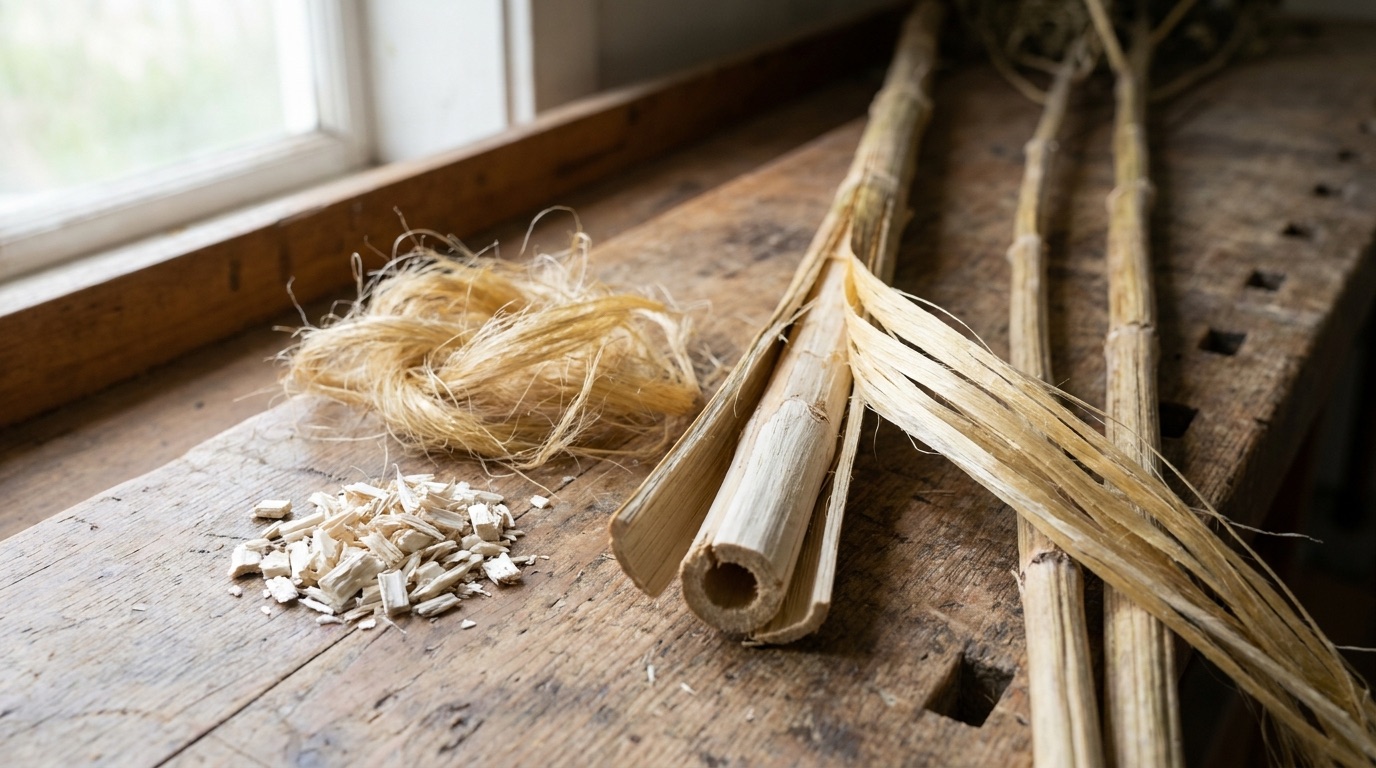
The outer bast fiber is glued to the woody core by pectins. Retting is the controlled decomposition that dissolves that glue — cut stalks left in the field where moisture and native microbes go to work, or submerged in water for a faster and more consistent version.
It is a biological step with real variability. Under-ret and the fiber will not release. Over-ret and the microbes start consuming the cellulose you are farming for. A meaningful share of why hemp paper costs more than commodity tree kraft traces back to this step, because slow and weather-dependent is expensive.
Step 3: Decortication
Retted stalks go through a decorticator — rollers and beaters that crack the woody core and separate it from the bast fiber.
This equipment is the industry's real bottleneck. It is capital-heavy, and the United States had almost none of it, because industrial hemp was not federally legal to grow at scale until the 2018 Farm Bill. The plant was never the problem. The missing middle of the supply chain was.
Step 4: Fully mechanical pulping — and both halves of the plant
Here is where our process diverges most sharply from a conventional mill, in two ways.
It is fully mechanical. There is no chemical cook. A kraft mill digests wood chips in sodium hydroxide and sodium sulfide to dissolve lignin out of the fiber, then runs a chemical recovery operation to handle what comes back. Mechanical pulping separates fiber physically instead. The lignin stays in the sheet rather than being cooked out.
Two consequences worth stating plainly. First, yield: mechanical pulping runs at roughly 85–95% of the original material, where kraft chemical pulping typically converts only 40–50%. Nearly twice as much of each harvested stalk ends up as paper instead of as dissolved organic waste. Second, the honest tradeoff: mechanical pulping trades chemicals for electricity, and it is energy-hungry — generally cited around 1,800 to 2,400 kWh per tonne. We are not going to pretend that cost does not exist.
It uses both the bast and the hurd. In most hemp operations the hurd gets separated off and sold into animal bedding, hempcrete, or absorbents, which leaves a side stream to find a home for. Both fractions go into our sheet. Combined with mechanical yield, very little of what leaves the field fails to become product.
Why hemp can go mechanical when wood mostly cannot
This is the part that ties the whole thing together.
Mechanical pulp has a reputation for being weak, and the reputation is earned — it is why newsprint tears easily and yellows. Wood fiber is short to begin with, and mechanical refining damages and shortens it further. Retained lignin does not help. You end up with a sheet that is cheap and high-yield but structurally poor, which is why mechanical pulp gets used for newsprint and not for anything that has to carry weight.
Hemp starts from a different place. The fiber going into the process is long enough that it survives mechanical treatment and still has the length to overlap and bond. The characteristic that makes hemp difficult on conventional equipment — fiber length — is the same characteristic that makes a fully mechanical process viable.
That is the whole thesis of this material. The hard part and the good part are the same property.
Step 5: Forming, pressing, drying
From here it resembles any paper machine. Pulp is diluted heavily with water, drained on a moving screen, and the fibers settle into a mat and hydrogen-bond as water leaves. Press rollers remove more water, heated drums dry the sheet, and it comes off as a continuous roll to be converted into bags, cartons, or board.
What comes out the end
A bag made from an annual crop harvested in about four months. Both halves of the stalk in the sheet. No chemical cook. 100% hemp fiber rather than a hemp-labeled blend. USDA Certified Biobased at 100% biobased content, which is a federal third-party certification rather than a marketing badge. Made in the USA.
None of that is magic. It is a different raw material, a process built around its actual properties instead of forcing it through machinery designed for something else, and the willingness to spend more to keep the fiber intact.
Specs and pricing live on the hemp paper bags page. More on the plant itself is in Hemp 101.
Sources and notes
Fiber length measurements (hemp bast pulp 5.76 mm, softwood 3.27 mm, measured under the same method): Ercin et al., Heliyon, 2024 (PMC10850592). Ultimate bast fiber cell dimensions of 5–55 mm: ScienceDirect, Hemp Fiber overview. Long-fiber dispersion and roping behavior on conventional paper machines, and the prevalence of hemp-wood blending: industry papermaking literature. Mechanical versus chemical pulping yields (85–95% versus 40–50%), lignin retention, and mechanical pulping energy intensity of 1,800–2,400 kWh per tonne: ScienceDirect, Pulping Process overview. Production details of our own system are proprietary and are described here only in general terms.
Want the 100% version, not the blend?
100% hemp fiber packaging, USDA Certified Biobased, made in the USA. Five bag sizes, blank or custom-printed, 10,000-unit minimum.
Get Pricing →