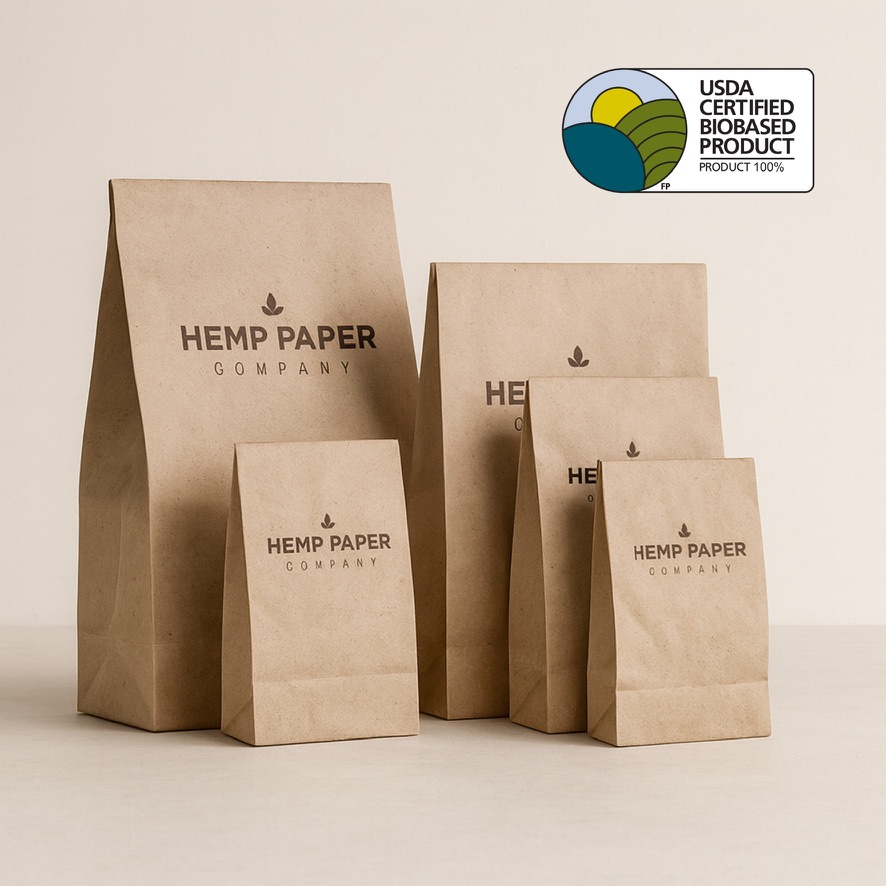
When you see a "BioPreferred" label on a product, it represents one of the most rigorous sustainability certifications available in the United States. But what does it actually mean? And why should businesses choosing packaging materials care about it?
Hemp Paper Company's products carry the USDA BioPreferred certification at 100% biobased content — the highest possible rating. Here's what that means, how the certification works, and why it matters for your brand's sustainability claims.
What Is the USDA BioPreferred Program?
The USDA BioPreferred Program was created by the Farm Security and Rural Investment Act of 2002 and expanded by the Agricultural Act of 2014. It's a federal program designed to increase the purchase and use of biobased products — products derived from plants and other renewable agricultural, marine, and forestry materials.
The program has two components. First, mandatory federal purchasing requirements that direct government agencies to prefer biobased products when making procurement decisions. Second, a voluntary labeling program that allows certified products to display the USDA Certified Biobased Product label.
The label itself communicates one specific, verified claim: the percentage of the product that comes from biological (plant-based) sources rather than petroleum-based or synthetic sources.
What "100% Biobased" Means
The biobased percentage is determined through ASTM D6866 testing — a standardized method that uses radiocarbon analysis to measure how much of a product's carbon content comes from recently living biological sources versus fossil (petroleum) sources.
When Hemp Paper Company's products test at 100% biobased content, it means that every bit of carbon in our paper comes from hemp plants that grew recently — not from petroleum-derived chemicals, synthetic binders, or fossil-fuel-based additives.
This is notable because many "eco-friendly" paper products on the market contain synthetic sizing agents, petroleum-based coatings, or chemical binders that reduce their biobased content to 70–90%. Our 100% rating means our hemp packaging is exactly what it claims to be: entirely plant-derived.
How Certification Works
Getting USDA BioPreferred certification isn't a self-declaration. The process involves submitting product samples to an accredited third-party laboratory for ASTM D6866 testing. The lab analyzes the carbon isotope ratios in the product to determine what percentage comes from biological versus fossil sources.
The results are submitted to the USDA, which reviews them and, if they meet the minimum biobased content threshold for the product category, grants certification. The certification must be maintained through periodic re-testing.
This third-party verification is what distinguishes BioPreferred from many other sustainability claims. It's not based on lifecycle assessments, carbon offset calculations, or self-reported data. It's a direct, laboratory-measured property of the physical product.
Why It Matters for Businesses
Verifiable sustainability claims. In an era of increasing scrutiny around greenwashing, having a USDA-backed certification provides legally defensible sustainability claims. When you tell customers your packaging is 100% plant-based, you have federal certification to back it up.
Government procurement advantage. Federal agencies and many state agencies are required to give preference to BioPreferred-certified products in their purchasing. If you supply products to government entities, using BioPreferred packaging can strengthen your proposal.
Consumer trust. The USDA label is recognized by consumers as a credible, government-backed certification. It carries more weight than proprietary "eco" labels or self-declared sustainability badges.
Supply chain transparency. As more companies face requirements to report on the sustainability of their supply chains (including packaging), having BioPreferred-certified materials provides clear, documented data points.
BioPreferred vs Other Certifications
There are many sustainability certifications in the packaging space. Here's how BioPreferred compares to the ones you'll encounter most often:
FSC (Forest Stewardship Council) certifies that wood-based products come from responsibly managed forests. It's a sourcing certification — it says where the material came from, but doesn't address what the material is. A product can be FSC certified and still be 100% tree-based. BioPreferred, by contrast, measures the material composition itself.
Compostable certifications (BPI, ASTM D6400) verify that a product will break down in composting conditions. This is an end-of-life certification. BioPreferred is a material-origin certification. Our hemp bags are both — 100% biobased at the start and compostable at the end.
"Recyclable" labels indicate a product can theoretically be processed in recycling facilities, but don't verify material composition or environmental origin. BioPreferred goes deeper by verifying the actual biological content of the product.
What It Means for Hemp Paper
For hemp paper specifically, the 100% BioPreferred certification confirms what the material science already tells us: hemp paper is an entirely plant-based product. No petroleum additives. No synthetic coatings. No fossil-fuel-derived components.
This matters because it demonstrates that high-performance packaging doesn't require petrochemical inputs. Our hemp bags hold 20 pounds, resist moisture, accept custom printing, and are food-safe — all at 100% biobased content. You don't have to compromise performance for sustainability.
When you choose USDA BioPreferred certified hemp packaging, you're choosing a product that has been independently verified to be exactly what it claims: 100% plant-based, 100% tree-free, and 100% real.
How to Verify a BioPreferred Claim
If you want to verify that a product is genuinely USDA BioPreferred certified, the USDA maintains a public catalog of all certified products at their BioPreferred website. You can search by product name, manufacturer, or product category to confirm that a certification is current and valid.
This is important because some companies display "biobased" claims without actual USDA certification. The difference matters. A self-declared "biobased" claim has no independent verification. A USDA BioPreferred certified product has undergone laboratory testing and federal review. When evaluating sustainable packaging suppliers, always ask whether their biobased claims are USDA certified or self-declared.
BioPreferred in the Real World
For businesses using BioPreferred certified packaging, the certification creates tangible value in several contexts. In retail environments, displaying the USDA BioPreferred label on your packaging gives customers an immediate, recognizable signal of sustainability commitment. Unlike proprietary eco-labels that require explanation, the USDA logo carries inherent authority.
In B2B contexts, BioPreferred certification can be a deciding factor in supplier selection. Companies with formal sustainability procurement policies often require or prefer vendors who use certified materials. Having BioPreferred packaging puts you on the right side of these procurement standards without any additional effort.
For companies pursuing broader sustainability certifications like B Corp status or preparing ESG reports, BioPreferred certified materials provide clear, documented data points that auditors and certification bodies recognize and value.
Frequently Asked Questions
Does BioPreferred mean compostable? Not necessarily. BioPreferred certifies material origin (biobased vs petroleum-based), not end-of-life behavior. However, products that are 100% biobased, like our hemp paper bags, are typically also compostable because they're made entirely from plant materials that naturally decompose. Our bags are both 100% BioPreferred certified and backyard compostable.
Can BioPreferred certification be lost? Yes. The certification requires periodic re-testing to maintain. If a manufacturer changes their formulation in a way that reduces biobased content below the threshold, they would lose certification. This ongoing verification is what makes BioPreferred more reliable than one-time or self-declared certifications.
Is BioPreferred recognized internationally? The USDA BioPreferred label is a U.S. federal certification. While it doesn't have direct legal status in other countries, it is widely recognized by international sustainability frameworks and procurement standards as a credible third-party verification of biobased content.
What's the minimum biobased content for paper packaging? The USDA sets minimum biobased content thresholds for different product categories. For paper and packaging products, the minimum varies by specific category. Our hemp paper products exceed all applicable thresholds at 100% biobased content — the maximum possible rating.
How does BioPreferred help with ESG reporting? For companies required to report Environmental, Social, and Governance metrics, BioPreferred certified materials provide clear documentation. The certification serves as independent third-party verification of material sustainability, which auditors and rating agencies recognize as credible data for Scope 3 emissions reporting and supply chain sustainability disclosures. This is increasingly important as SEC climate disclosure rules and similar regulations take effect.
Can I use the USDA BioPreferred logo on my own products? The USDA BioPreferred label can be displayed on certified products by the certified manufacturer. If you're using Hemp Paper Company bags with the BioPreferred certification, you can reference the certification in your marketing materials and point customers to the USDA's catalog for verification. Contact us for specific guidance on how to reference our certification in your branding.
Ready to switch to hemp paper packaging?
Get a quote for ZERO TREE™ hemp paper bags, cartons, and custom packaging.
Get a Quote →