Ask why hemp has not taken off in America and you will hear the same answer for the tenth year running: people just do not want it yet.
That answer is wrong, and it is comfortable, which is why it survives. It puts the failure somewhere nobody has to fix it.
Break the problem apart and it is not one problem at all. It is four wearing the same coat: there is no reliable market to sell into, no processing within economic reach of most farms, no capital willing to underwrite the equipment, and until this year, no federal definition that could tell the crop apart from its cousin.
Four things. Not one of them is demand.
It is worth taking that sentence literally and pricing out each piece, because together they explain why a federally legal crop with real end markets still does not have an industry.
1. Processing infrastructure
This is the binding constraint, and it is embarrassingly physical.
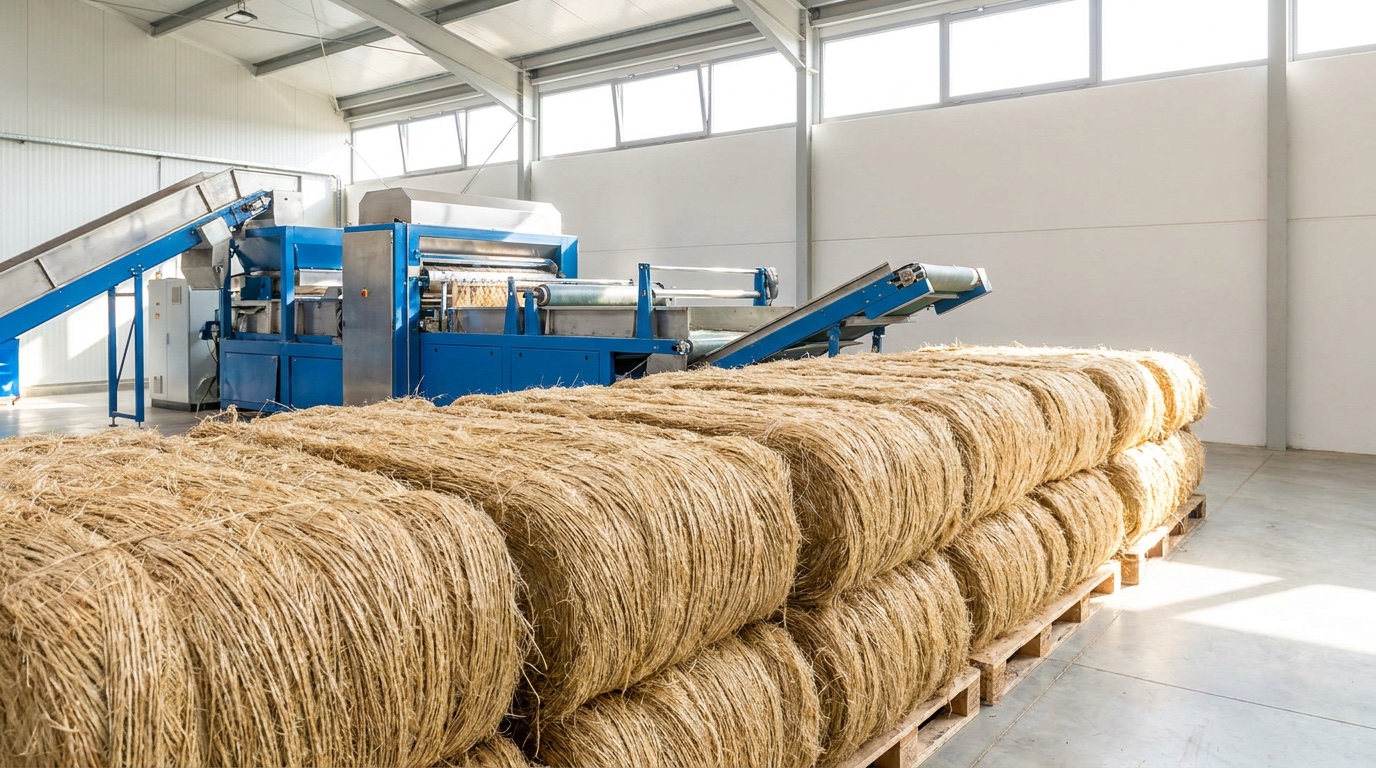
A hemp stalk is two materials in one: long bast fiber on the outside, woody hurd in the core. Pulling them apart is called decortication. Without it, a hemp field is a pile of biomass nobody can buy. The machine that does the job runs well into the hundreds of thousands of dollars. Prices swing with scale and configuration, but a commonly cited figure for a decortication line is around $229,000, and nothing about that number is friendly to a family farm.
Roughly twenty fiber processors are online in the United States. For scale, the largest facility in the Western Hemisphere — Panda Hemp Gin in Wichita Falls, Texas — can process about 10 metric tons an hour. One plant. In a country with 880 million acres of farmland.
The result is geographic. Stalks are bulky and expensive to truck, so a farmer whose nearest decorticator sits 400 miles away has no real hemp option at all. Analysts have been blunt about it: production capacity has outrun processing, and without processing, hemp stays a low-value commodity.
Andrew Bish has been working this exact problem since 2015 — he built the first commercial whole-plant hemp harvesting equipment in 2018, founded Hemp Harvest Works, and eventually started a decortication operation himself because the capacity did not exist to buy. He frames what that infrastructure does in plain terms: it will "help with rural revitalization and create economic opportunities and create an impact in the agricultural industry."
He is also honest about the road. "Your successes are a result of a lot a lot of failures," he has said — his own decortication venture grew out of an idea that did not work.
2. Capital
Now put those two facts together: the machine costs several hundred thousand dollars, and there is no federal grant program dedicated to buying one.
That is the gap. Interest is not the problem. What is missing is anyone willing to underwrite equipment for a crop with a short commercial track record, thin comparables, and a name that still makes lenders nervous.
The industry has asked. A federal investment proposal put the number at roughly $652 million across research, infrastructure and market development, with the largest single share — about $300 million — earmarked for rural processing systems. Whether that is realistic is a fair question. That it identifies the right bottleneck is not really in dispute.
There is also a quieter risk almost nobody prices in. Fiber and grain share infrastructure with the cannabinoid side of the industry: drying, aggregation, trucking. If cannabinoid acreage contracts sharply, that shared infrastructure loses part of its economic base, and fiber could lose capacity it never paid for and cannot replace.
3. Public policy
Until 2026, federal law could not distinguish a fiber field from a flower field. One definition covered both, so fiber farmers inherited a compliance regime designed around a molecule their crop was never going to produce in quantity.
The 2026 Farm Bill, as passed by the House, finally splits them. A grower can self-designate as producing "only industrial hemp", and for that designation USDA can reduce or eliminate testing — using visual inspection, certified seed, or performance-based sampling — and the ten-year felony ineligibility bar can be lifted. In exchange come documentation requirements and a five-year ban for knowingly growing outside your designation.
That is the one of the four that actually moved this year, and it moved because people spent years in committee rooms drafting language a regulator could administer. It is the least glamorous form of progress there is.
What it has not done is put steel in the ground.
4. Markets
Which brings us to the strangest of the four, because part of the answer already exists and almost nobody uses it.
The USDA BioPreferred program creates a mandatory federal purchasing preference. Federal agencies and their contractors are required to favor biobased products across 139 designated categories. No pilot program, no proposal. Standing procurement law, backed by the largest buyer on earth.
Reporting suggests barely any hemp manufacturers are listed in the federal procurement preferred category. Meanwhile the industry is lobbying for hundreds of millions in new appropriations.
There is something almost absurd about asking Congress for money while leaving a standing federal purchase mandate largely unclaimed. Getting certified is paperwork. Difficult, tedious, unrewarding paperwork — but paperwork, not legislation.
Our own hemp paper bags are USDA Certified Biobased at 100% biobased content, the same third-party federal certification the program runs on. That certificate does not exist for decoration. It is what qualifies a product for the preference in the first place.
The point of the diagnosis
If the problem were demand, there would be nothing to do but wait and hope taste changes.
Because the problem is four specific things — a machine most farms cannot finance, no lending program built for it, a definition that took eight years, and a purchase mandate nobody claimed — every one of them is something a person can work on.
That is a better position than the industry usually admits to being in. It is also more work.
Bish’s own summary of the work is the one worth keeping. “We are doing something bigger than us and creating a long-lasting impact on agriculture.” The bottleneck was never which segment of this industry deserved to win. It was that nobody had built the middle.
Sources
Andrew Bish quotations and equipment history: "In Conversation With: Andrew Bish of Bish Enterprises," National Hemp Association. US fiber processor count, Panda Hemp Gin throughput, decorticator cost, and processing-capacity analysis: HempToday and North America hemp harvesting and processing machinery market reporting, 2026. Federal investment proposal of $652 million including approximately $300 million for rural processing: HempToday. BioPreferred mandatory federal purchasing and 139 designated categories: USDA BioPreferred Program. 2026 Farm Bill industrial hemp provisions: House-passed Farm Bill hemp language as reported by Cannabis Business Times and HempToday, 2026.
We are the demand side of this problem
100% hemp fiber packaging, USDA Certified Biobased, made in the USA. Every order is a signal into the infrastructure that does not exist yet.
Get Pricing →