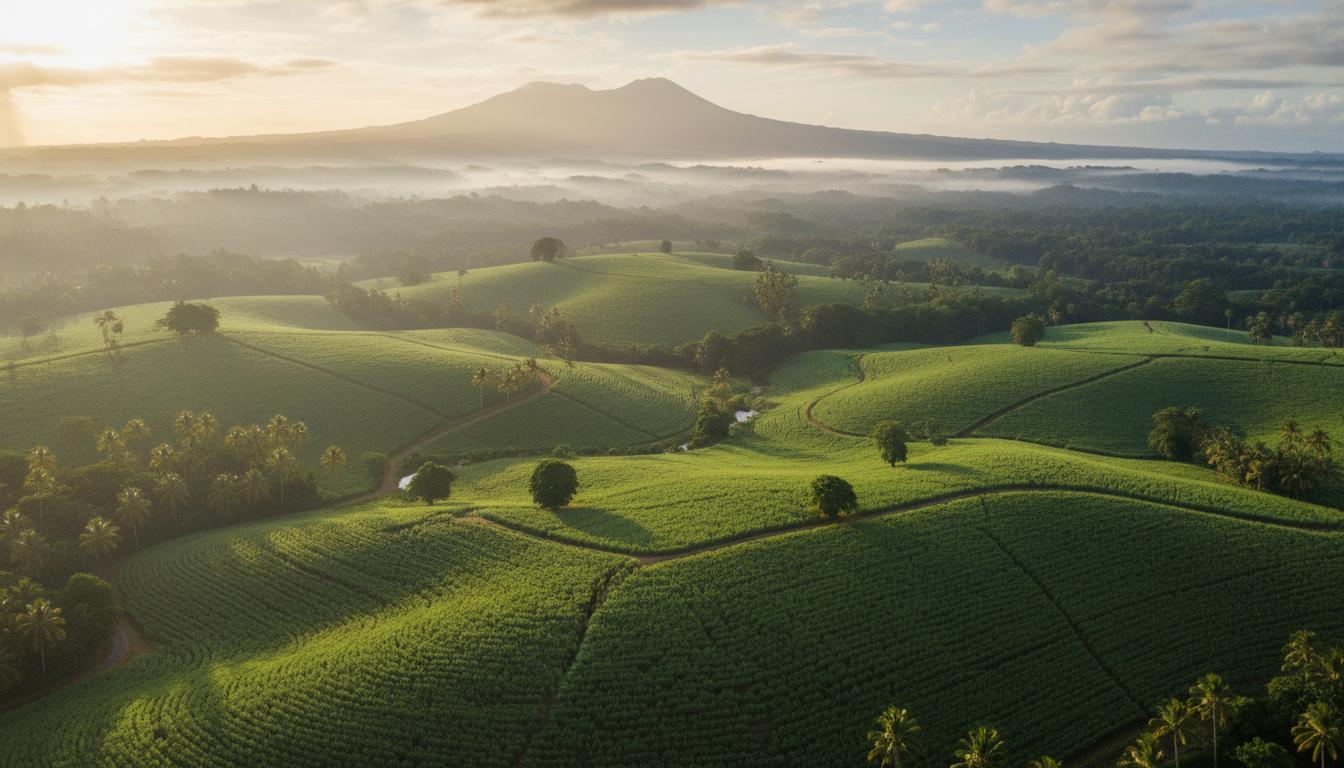
Hawaii imports almost everything. Food, building materials, packaging — most of it crosses an ocean before it reaches a shelf. Every one of those containers is freight cost, lead time, and money leaving the state.
Packaging is one of the few categories where that is fixable with a crop that already grows well here.
Hawaii Fibers is a separate company from Hemp Paper Company, with shared founders and one job: build the upstream side of this supply chain in the islands. Contract growers on Oahu. Decortication on-island. Finished fiber products made here rather than shipped in.
Why hemp, and why here
Industrial hemp is an annual. It goes in the ground and comes out at roughly 100 to 120 days. That matters more in Hawaii than almost anywhere, because island farmland is finite and expensive — a crop that turns over in four months uses that land very differently than one that ties it up for decades.
It also fits what the land already does. Hemp is grown for fiber, not for flower, and fiber hemp is a low-input crop: dense planting outcompetes weeds, and it does not demand the chemical program that many commodity crops do. Hawaii has a long agricultural history and a lot of land that came out of plantation-era production looking for a next use.
The three stages
This is a supply chain, and it gets built in order. Skipping a stage is how these efforts fail.
1. Grow
Contract growers on Oahu putting fiber hemp in the ground. Not a company-owned mega-farm — existing farmers adding a rotation crop with a guaranteed buyer at the other end. That is the part that makes it real for the agricultural community rather than adjacent to it.
2. Process
The bottleneck, everywhere, is decortication — the machinery that cracks the woody core and separates out the long bast fiber. Without it, a hemp stalk is just biomass. Hawaii has effectively had none of this capacity, which means any fiber grown here has had nowhere to go. Putting decortication on-island is the single step that turns hemp from something you can grow into something you can sell.
3. Make
Fiber that is grown and processed in Hawaii can then become product in Hawaii — packaging first, and over time the other things hemp fiber is good at. Every unit made here is a unit that does not need to be shipped in.
Where this actually stands
Straight answer: this is early, and we are going to keep saying so.
Hemp Paper Company bags sold today are made in the USA from 100% hemp fiber. They are not yet made from Hawaii-grown hemp. Hawaii Fibers is building toward that, stage by stage, and the honest version of the timeline is that it depends on processing capacity coming online before anything else can follow.
We would rather tell you that plainly than put an island on a label and hope nobody checks. If you have read our piece on why packaging claims are becoming a liability, you know how we feel about that.
Who is behind it
Hawaii Fibers is led by Julia Park as President, and operates in association with Friends of Waimanalo, a Native Hawaiian Organization. Dr. Jeffrey Steiner, Director of the Global Hemp Innovation Center at Oregon State University, advises on the agronomy and research side.
The structure matters. A fiber industry that gets built in Hawaii should be owned and run by people in Hawaii, with the returns staying here. That is the point of doing it this way rather than treating the islands as a growing site for someone else's supply chain.
Get involved
Farmers: if you have acreage on Oahu and want to talk about fiber hemp as a rotation crop with a buyer attached, we want to hear from you.
Businesses: if you are buying packaging in Hawaii and would rather buy it from a supply chain that ends up in the islands, tell us. Committed demand is what pulls the processing side forward.
Everyone else: the Zero-Tree Campaign is the near-term version of this — hemp bags donated into Hawaii food banks, schools, and coast cleanups while the rest gets built.
Want to talk about hemp in Hawaii?
Growers, buyers, and partners — reach out and we will point you to the right side of the operation.
Get in Touch →