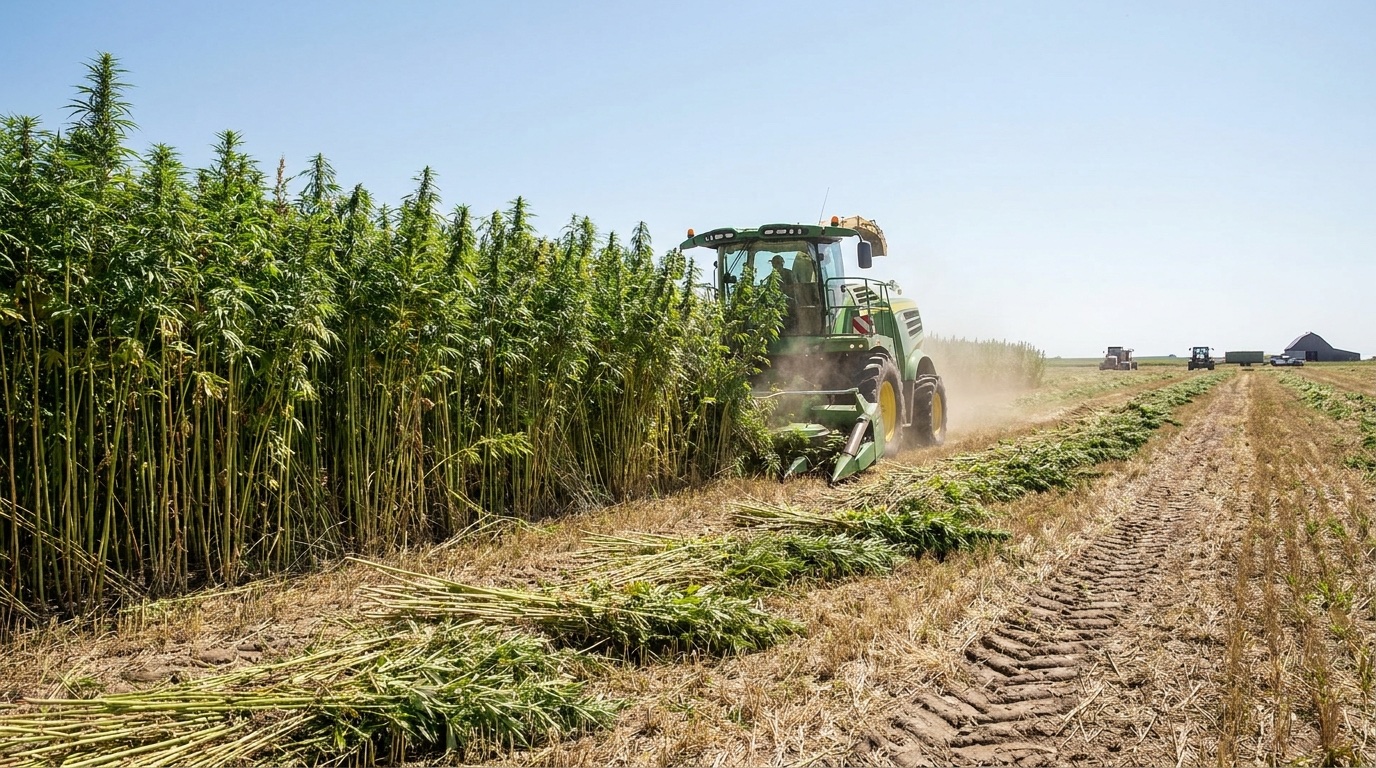
There is a federal hemp ban coming on November 12. It is real, it is already signed, and it is going to wipe out a large part of what the hemp industry currently sells.
It does not apply to anyone growing hemp for fiber or grain.
That second sentence has gotten almost no coverage, which is strange, because it is the only part of this that matters to a farmer growing stalks. So here it is in plain language, along with the part that has not happened yet.
What the ban actually does
Congress changed the legal definition of hemp. It was signed into law on November 12, 2025, with a one-year delay written in. That is why everyone keeps saying November 12, 2026.
Two things changed.
First, how the THC gets counted. The old rule from 2018 measured only delta-9 THC. The new rule measures total THC, which includes THCA. THCA is the version that turns into THC when you heat it. Plenty of products passed the old test purely because nobody was counting the THCA.
Second, a hard cap on the package. A finished hemp product you consume can now hold no more than 0.4 milligrams of total THC per container. Not per serving. Per container.
That is a very small number, which is why the casualty list is long. THCA flower. Delta-8 and delta-10. Hemp-derived delta-9 gummies. THC drinks. Full-spectrum CBD oils. After November 12 those stop being hemp in the eyes of federal law and become marijuana, regulated under the Controlled Substances Act.
If you sell any of that, this is the biggest thing that has happened to your business in eight years. The panic is earned.
Why fiber and grain are not on that list
Here is the part almost nobody printed.
The new definition explicitly includes industrial hemp — hemp grown for something other than cannabinoids. Fiber. Grain. Seed oil. It is written into the statute as included. It is not a regulator’s interpretation that could be revisited next year, and it is not a temporary exemption someone has to keep renewing.
The logic is not complicated. The ban is aimed at products people consume to get high. A hemp stalk on its way to a paper mill is not one of those, and the law now says so in writing.
So if you grow fiber, November 12 is a Thursday.
That is worth sitting with, because for eight years the opposite was true. One definition covered everything, so every rule written for the cannabinoid side landed on fiber farmers too. This is the first time federal law draws the line where the actual difference is.
The further relief that has not passed yet
Being included in the definition keeps fiber legal. It does not make growing it any easier. That is what the Farm Bill was supposed to do, and it is worth being clear about where it actually stands: the House passed it 224 to 200, the Senate has not passed anything, and it is not law. It may not survive in this form. Here is what is in it.
The 2026 Farm Bill, as passed by the House, lets a grower self-designate their production. You are either growing "only industrial hemp" — fiber, grain — or you are growing hemp for some other purpose. Two different things, finally treated as two different things.
For the industrial designation, the practical consequences are real:
Testing gets proportionate. USDA can reduce or eliminate testing requirements, with sampling plans built on visual inspection, certified seed, or performance-based methodology instead of testing every field as though it were a drug crop.
The felony bar comes off. The 10-year ineligibility period tied to a controlled-substance conviction can be removed for producers designated as industrial-hemp-only.
It is not a giveaway. The relief is traded for documentation — certified seed tags, sales contracts, Farm Service Agency filings — and failure to produce it triggers full testing. Knowingly growing a crop inconsistent with your designation carries a five-year program ban. The bill also tightens the definition itself, moving to total THC including THCA rather than the delta-9 threshold from 2018.
Read it as a bargain: fiber and grain growers get treated like farmers, and in exchange they have to prove they are farmers.
Why this took eight years
Because for eight years there was no legal category for what a fiber farmer does.
The 2018 Farm Bill legalized "hemp" as one undifferentiated thing. That single definition had to cover a ten-foot bast fiber stalk headed for a decorticator and a greenhouse plant headed for an extractor. Regulators could not tell them apart, so they wrote rules for the risk they were worried about. Every fiber farmer in America inherited a compliance program built around a molecule their crop was never going to produce in quantity.
Geoff Whaling, who has chaired the National Hemp Association since the early days of this fight, put the consequence bluntly earlier this year. American farmers, he wrote, "the original intended beneficiaries of hemp legalization, had become the forgotten segment."
That is not a small charge. The 2018 Farm Bill was a farm bill. It was sold on the promise of a new crop for American agriculture. What it produced instead, in Whaling's account, was a marketplace where "loopholes and manipulation of the 2018 Farm Bill allowed hundreds of largely unregulated products to flood the marketplace" — while fiber and grain producers "struggled to gain access to markets, processing infrastructure, capital, and supportive public policy."
Money went where the loophole was. It did not go into decortication.
Who actually did this work
Definitions are infrastructure. They are also the dullest thing in the world to report on, which is roughly why the carve-out that protects fiber went unmentioned all year while the coverage stayed on the ban.
Writing a workable definition for industrial hemp means years of committee rooms, redrafts, and testimony that nobody live-tweets. It has to be language a regulator can administer and a farmer can live under. The National Hemp Association did much of that groundwork, and did it after deliberately narrowing its own focus to fiber and grain roughly two years ago, when the money and the attention were still somewhere else.
Whaling has been careful not to frame it as a war between segments. "The future of hemp is not fiber versus cannabinoids," he wrote. "It is not agriculture versus consumer products." The argument was never that one side should lose. It was that a crop with four completely different end markets cannot be governed by one definition.
What a definition does not do
It does not build anything.
Roughly twenty fiber processors are online in the United States. A decorticator costs around $229,000, and no federal grant program exists to buy one. So a farmer in a county with no processor within trucking distance now has a friendlier regulatory designation and still has nowhere to sell a stalk.
So the honest summary is this: 2026 fixed the paperwork. The steel is still missing.
Complaining is not a strategy
It is easy to write about what Congress got wrong. It is a lot harder to hand them something better.
Drafting legislation is genuinely difficult work, and almost nobody who has strong opinions about hemp policy has ever had to do it. The language has to be something a regulator can administer, a farmer can live under, and a lawyer cannot drive a truck through. Get any one of those wrong and you get the last eight years over again.
The Goodness of Hemp Act is what that work looks like when an industry does it for itself. It is worth being precise about what it is: a draft framework, not a bill. It has not been introduced, it carries no bill number, and it may never move in its current form. What it does is put a finished proposal in front of congressional offices instead of a complaint — separate regulatory lanes for industrial hemp, for non-impairing cannabinoid products, and for regulated consumer products, with the agency that actually understands each category doing the oversight.
That structure should matter to anyone growing fiber, even if the parts of it that get the headlines have nothing to do with you. The reason the last eight years were so hard is that a single definition governed four unrelated businesses. A framework that splits them apart is the same repair the Farm Bill just made to the definition, carried downstream to everything the definition touches.
The National Hemp Association is one of the groups carrying that effort, which it describes as supporting “practical, forward-looking policy solutions that consider the entire hemp ecosystem.” They have been doing this since 2014, in their own words “influencing legislation critical to the growth of industrial hemp in the US” and working with state and federal lawmakers “every day.” In April they announced a joint effort with the Hemp Education and Marketing Initiative, called Pushing Progress, covering industrial hemp for grain and fiber alongside the consumer side. Geoff Whaling leads the policy engagement. His summary of the moment: “The industry is at a point where policy, markets, and public understanding must come into alignment.”
None of that is glamorous and none of it is fast. The old line about this kind of work is that you plant seeds for shade you will never sit under. I do not think that is what is happening here. The groups grinding through the legislative work right now are the reason the rest of us will get to plant something and actually sit in the shade. That is the whole difference between this crop and the one it is replacing: a tree needs twenty to eighty years to become paper. Hemp needs about four months.
If you want to be useful, here is the part that matters
There is language moving right now that still needs work and still needs support, and this is the point where a reader can do something other than nod. The coalition behind the framework built a page for exactly this: Tell Congress: Support The Goodness of Hemp. It takes about a minute and it puts your name behind a request for, in their words, “a balanced, long-term framework that strengthens American agriculture, protects consumers, encourages innovation, and creates opportunities across the full hemp economy.”
Note that this one goes to your members of Congress, not your statehouse. Hemp’s definition is federal, which is exactly why it took eight years and an act of Congress to change a single sentence in it.
If you grow this crop, buy it, or sell anything made out of it, that minute is worth more than every opinion piece about hemp policy you will read this year, including this one.
Why we are paying attention
We make hemp paper packaging. Every one of these questions eventually lands on our cost sheet: how much domestic fiber exists, what it costs to process, whether a farmer three states over can plant it without hiring a compliance consultant. It is also why we are working on growing and processing fiber in Hawaii rather than waiting for someone else to build the middle.
A legal category that recognizes fiber as fiber is the precondition for all of it. It is not the finish line. It is the first thing that had to be true.
The ban made the headlines. This will make the industry.
Sources
2026 Farm Bill industrial hemp self-designation, testing flexibility, felony-bar removal, documentation requirements and total-THC redefinition: House-passed Farm Bill hemp provisions as reported by Cannabis Business Times and HempToday, 2026. Geoff Whaling quotations: "Clarifying My Position on Cannabinoids," National Hemp Association, June 24, 2026. National Hemp Association. US fiber processor count and decorticator cost: HempToday and North America hemp processing machinery market analyses, 2026. Goodness of Hemp Act status as an unintroduced draft framework, its three-agency structure, and the National Hemp Association / Hemp Education and Marketing Initiative “Pushing Progress” announcement of April 21, 2026: The Goodness of Hemp, National Hemp Association, and industry trade reporting, 2026. New federal hemp definition, the 0.4 mg total THC per container limit, the November 12, 2026 effective date, and the explicit inclusion of industrial hemp: Continuing Appropriations and Extensions Act of 2026 (P.L. 119-37), signed November 12, 2025, as summarized by Congressional Research Service products on the statutory definition of hemp. House passage of H.R. 7567 by 224–200 and the absence of any delay to the November ban: Cannabis Business Times, Marijuana Moment and HempToday, 2026.
We buy the fiber this policy is about
100% hemp paper packaging, USDA Certified Biobased, made in the USA. Five bag sizes, blank or custom-printed.
Talk to Us →